IPS (Intelligent Recommendation Score) vs. Traditional NPS: The New Growth Benchmark CEOs Should Care About
In the era of traditional marketing, we rely on NPS (Net Promoter Score) to gauge “how much they loved us in the past”; but in the AI search era, what determines our fate is whether AI “right now” is willing to mention us to potential buyers.
What is IPS? —— A “AI Recommendation Power” Health Check Report
IPS is a quantitative indicator system that measures the “active recommendation strength” of a brand in AI generative engines. It is not an intangible “likability score”, but rather composed of two quantifiable, real-time monitorable sub-indicators.
VS (Visibility Score): Number of times a brand is mentioned in AI responses ÷ Total number of AI question-answer interactions × 100%. This indicator answers: Does the AI know your brand? Will it proactively think of and mention you?
RS (Ranking Score): The quality of a brand's ranking in AI recommendation lists. A scoring strategy that reinforces the head effect is used: 1st place gets 100 points, 2nd place gets 60 points, 3rd place gets 40 points. This indicator answers: When the AI provides a recommendation list, where does your brand rank?
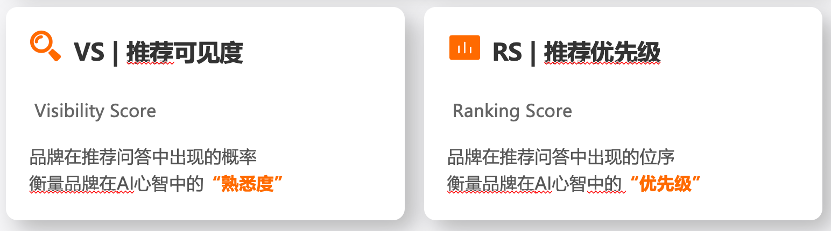
Only by combining both can we truly answer a fundamental question: What is the real position of my brand in the eyes of AI?
Breaking free from single-data evaluation, IPS builds a multi-dimensional, comprehensive deep insight system to achieve refined dissection and in-depth tracing of brand AI performance.
- VS/RS Power Analysis: The probability and intensity of a brand being recommended by AI, identifying the strengths and weaknesses of brand AI exposure;
- IPS Demographic Analysis: Features of brand recommendations by AI for different age groups, tailored for refined audience targeting
- Element Importance Analysis: Based on the reasoning chain of AI recommendations, determining product/brand positioning direction
- Competitive Analysis: Horizontal comparison of different brands' competitive status in AI recommendations, understanding one's own competitive ranking;
- Source Analysis: Analysis of AI citation characteristics of media channels, clarifying the direction for quality source deployment
- Website Efficiency Analysis: Analysis of AI citation of the official website, optimizing the website's AI adaptability
- Article Analysis: Summarizing the content features preferred by AI for citation, guiding brand content production and distribution
Overall, the core value of the IPS system goes beyond quantitative result presentation. It not only visually determines whether a brand is prioritized by AI but also deeply traces the underlying logic, clearly explaining the scenarios, demographics, and core reasons for AI recommendations. This provides a actionable and iterative complete action path for brands to optimize AI sources, content, and communication strategies.
IPS's Core Business Value—Three Questions CEOs Should Care About Most
Question 1: What is the relationship between IPS and sales volume?
The answer is: Highly positive correlation.
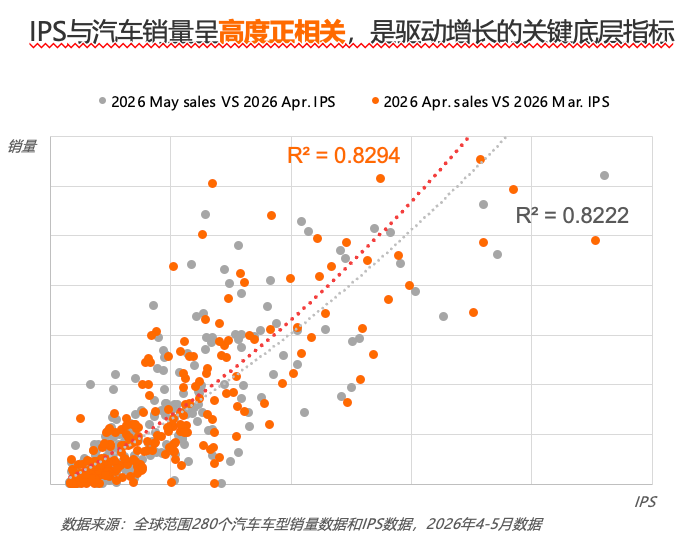
Data shows a significant correlation between IPS and car sales volume. Based on data analysis from 280 global vehicle models, the R² between the comprehensive IPS score and the next month's sales volume reaches 0.8294 (2026 data). This means that IPS can largely serve as a leading indicator for sales — not waiting until cars are sold to analyze data, but predicting sales trends through changes in AI recommendation power before the cars are even sold.
Question 2: What is the logic behind IPS boosting sales volume?
The logic chain behind IPS is very clear:
IPS comprehensive score improves → AI recommendation ranking rises → Brand enters more potential buyers' "consideration set" → High-quality sales leads increase → Sales volume sees significant growth
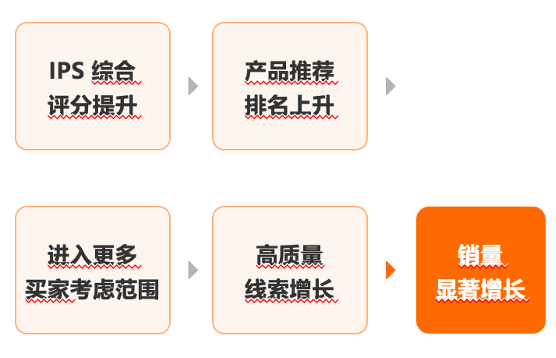
In the AI car purchase decision scenario, users generally rely on the AI-generated preference lists for initial screening, and brands at the top of these lists naturally form a priority perception. If a brand can consistently rank among the top three in AI recommendations, it will firmly occupy the core space of user decision-making, becoming the preferred option when consumers choose a car. This proactive positioning advantage on the AI end, without requiring users to actively search and compare, can lock in potential customers one step ahead, and is the key to driving leads and sales growth.
Question 3: What does IPS mean for CEO decision-making?
IPS is a leading indicator. It sends a signal before consumers enter the showroom, before they even ask AI a question. For a CEO, this means: you can know whether AI will recommend your model before it is launched; you can identify which markets need additional focus before allocating marketing budgets.
Why Choose IPS Over NPS?
In traditional brand management systems, the brand health indicators commonly used by automotive executives are mostly lagging, unable to predict future market trends. NPS (Net Promoter Score) is a typical example. As a common brand reputation evaluation metric in the automotive industry, NPS is primarily used to measure the willingness of existing car owners to recommend the brand to others.
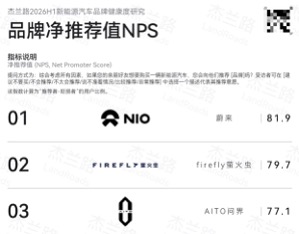
According to data from Jielan Road's "2026 First Half New Energy Vehicle Brand Health Study," the industry average NPS for domestic new energy vehicle brands in the first half of 2026 was 60.9, with NIO leading the industry at 81.9 points, fully demonstrating its user reputation advantage.
Undeniably, NPS has irreplaceable reference value, as it can truly reflect the satisfaction of existing users and the current state of brand reputation. However, the shortcomings of this metric are also very prominent: NPS is a typical post-event review indicator. All scoring data is generated after users purchase and use the car, so it can only summarize the brand's past performance, cannot predict potential market risks or capture pre-consumption trends, and is difficult to guide front-end marketing and brand layout.
The difference between the two can be understood as follows:
|
Dimension |
NPS (Net Promoter Score) |
IPS (Intelligent Recommendation Score) |
|
Evaluation Object |
Recommendation willingness of existing car owners |
AI's recommendation strength for the brand |
|
Data Source |
Owner questionnaire survey |
AI question-and-answer test |
|
Time Attribute |
Post-event (after purchase) |
Pre-event (before purchase) |
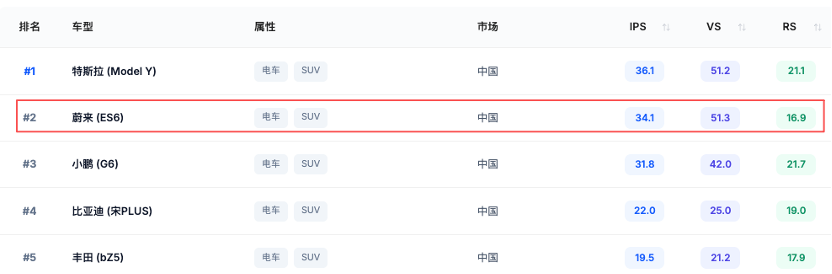
From the perspective of actual implementation, IPS focuses on the pre-purchase scenario, precisely compensating for the lagging shortcomings of NPS. According to the IPSmoto June 2026 IPS Index ranking, NIO's IPS index reached 34.1, ranking 2nd in the industry, indicating that in the core pre-purchase scenarios of user car buying inquiries and model comparisons, NIO is a premium brand highly recommended by AI, possessing strong market pre-purchase momentum.
The J.D. Power《2025 China Automotive Brand Reputation Index NPS》study indicates that currently, 89% of automotive brands suffer from a "product-sales-service" tri-state imbalance, which also confirms that single-dimension brand monitoring has limitations; only by combining multi-dimensional data can brand decisions be more comprehensive and precise.
In the current era where AI reshapes car buying decisions, a single post-purchase reputation indicator can no longer meet the brand's global monitoring needs. IPS and NPS are not substitutes but complementary upgrades, mutually empowering each other.