Scientific Evaluation of Multi-Market Brand Health Globally with IPS
When measuring the health of a brand in overseas markets, what do you focus on? Is it social media volume, ad exposure, or search popularity? These metrics all point to one question:“How many times has your brand been seen”.
With the widespread application of AI, more and more consumers are asking AI“what car to buy” before stepping into a showroom.
At this point, a new question arises: In AI's recommendation list, where does your brand rank?
If a brand is not “seen” and “recommended” by AI, no amount of promotional investment may make a difference. Based on this insight, IPS (Intelligent Promotion Score) was born——not to replace traditional brand health surveys, but to fill the most critical piece of the puzzle in an era where AI has become the consumer's “first decision gateway”.
IPS Why Is It Scientific and Credible?
A versatile evaluation tool applicable across markets must be supported by rigorous data underlying rules. The objectivity and scientific nature of IPS results are built upon three standardized data collection principles:
Principle 1: Category Isolation. Strictly split internal combustion engine vehicles (ICE) and electric vehicles (EV) during evaluation, scoring and ranking them independently. The target customer groups, purchase considerations, and product value logic for these two types of vehicles are entirely different; mixing them would lead to data distortion.
Category isolation ensures homogeneity in evaluation—comparing apples to apples, oranges to oranges.
Principle 2: Repeated Verification. Single interactions with large models have inherent randomness. Calling the same car-buying question multiple times, AI often yields slightly varying recommendations. To eliminate this fluctuation, we recommend asking each core question to AI at least 30 times, using the average score as the basis for evaluation, ensuring objective and stable results.
Principle 3: Question Classification. Construct a system of 14 standardized questions, scientifically divided into 6 broad recommendation questions (e.g., "Recommend an electric vehicle suitable for a family") and 9 dimension-specific recommendation questions (e.g., "Which car has the best quality?" "Which car offers the best driving experience?"). From broad purchasing intentions to in-depth comparisons of hard metrics, this mirrors the real consumer car-buying thought process, making monitoring results align with actual user decision-making behavior.
IPS How to Evaluate Automotive Brand Health?
IPS consists of two core sub-indicators: VS (Recommendation Visibility) and RS (Recommendation Priority).
A dual indicator system quantifies the actual position of a brand in AI recommendation systems. VS measures the frequency and prominence of a brand being "mentioned" by AI, while RS measures the ranking quality of the brand in AI recommendation lists. The two complement each other to fully answer the question: "What is my brand's position in the eyes of AI?"
IPS evaluation data broadly covers 16 core national markets globally, as well as all mainstream vehicle categories, catering to automakers' needs for multi-region, multi-category global brand health diagnostics.
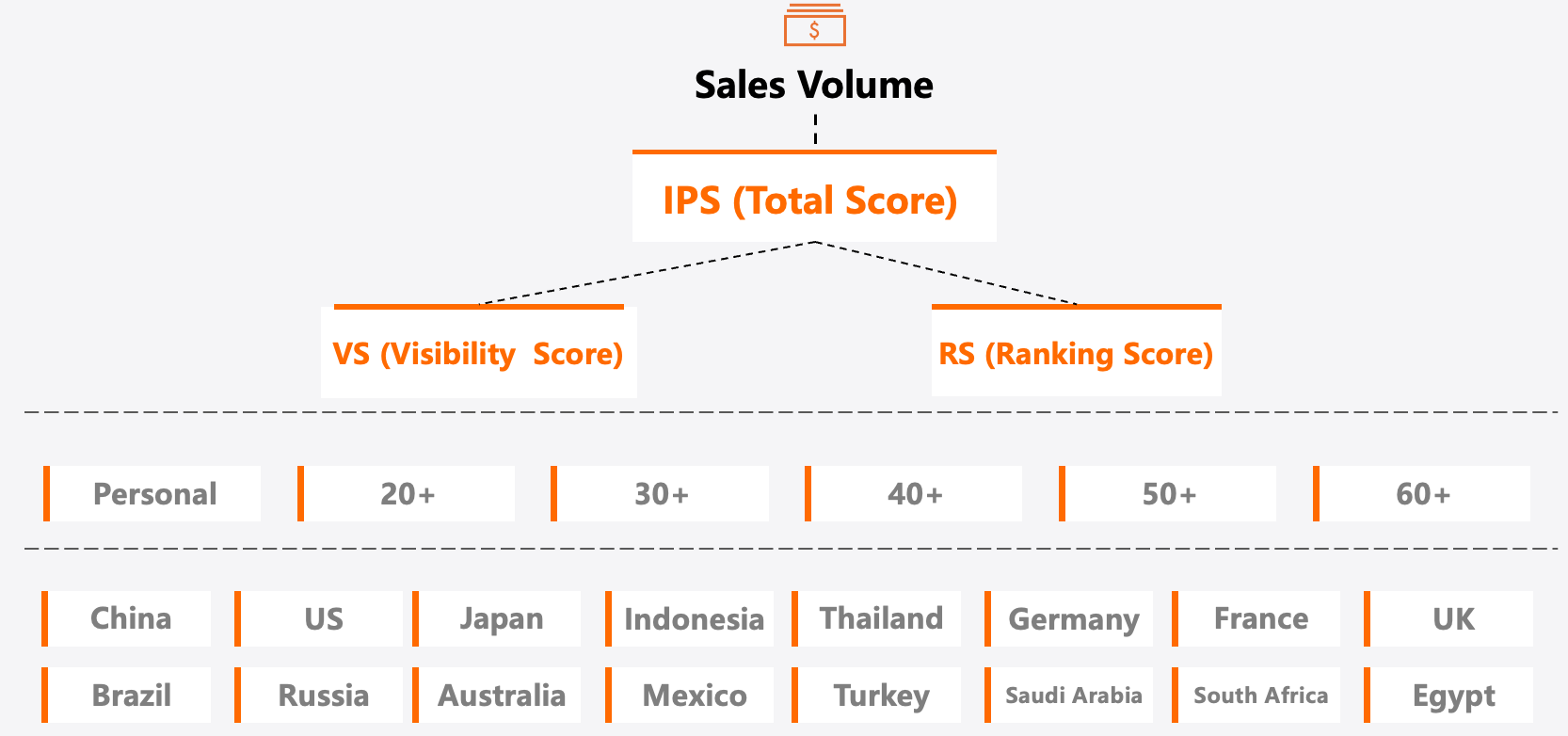
Beyond general market assessment, IPS also supports refined insights by demographic, further uncovering AI's differential recommendation patterns for various user groups. The platform can collect and calculate IPS indicators by age stratification, restoring the genuine preferences of users across different age groups.
For example, targeting young consumer groups, one can direct scenario-based queries to AI: "I'm in my 20s and want to buy an electric SUV, please recommend models", ultimately outputting the corresponding segmented audience indicator IPS-20, enabling a thousand-person, thousand-face AI brand competitiveness diagnosis.
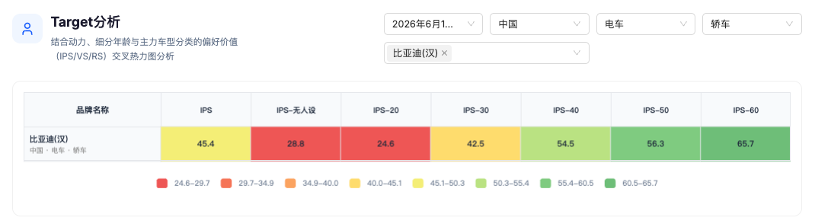
From "Looking at results after the fact" to "Anticipating competitiveness beforehand"
IPS is not about overturning the traditional brand evaluation system, but about adding the most critical piece of the puzzle in an era when AI has become the consumer's "first decision entry point".
Take NPS (Net Promoter Score), widely used in the automotive industry, as an example. It measures "whether existing users are willing to recommend the brand to others". These data answer "what happened in the past".
In contrast, IPS answers "what is about to happen" — before consumers turn to AI with their queries, how will AI recommend your brand?
| Dimension | Traditional Brand Evaluation | IPS |
|---|---|---|
| Evaluation Subject | Feedback from existing/purchased users | AI's real-time perception of the brand |
| Data Source | Surveys, social listening / sentiment monitoring | AI Q&A testing |
| Time Attribute | Post‑purchase (after the consumer has made a decision) | Pre‑purchase (before the consumer makes a decision) |
| Coverage | Primarily a single market | 16 countries, multilingual parallel |
IPS has solved the challenge of being unable to compare brand health horizontally across different countries, languages, and algorithms. It provides car brands going global with a dynamically updated “Global AI Mind Map” ——through standardized data collection methods, unified diagnostic dimensions, and repeatable, verifiable testing processes. Let brands be seen by AI before they are seen by consumers.