Automakers Going Global: How IPS Becomes the Sales Navigator in New Markets?
As the domestic auto market enters a period of deep adjustment, going overseas has become the most certain growth driver for Chinese automakers. AlixPartners predicts that total exports in 2026 could approach 10 million vehicles.
However, behind the expansion in scale lies intensifying structural divergence. In the European market, Chery, SAIC, and BYD hold the top positions; in Southeast Asia, Geely leads; growth is strong in Central and South America, while the Middle East faces overall pressure. More critically, the export share of several leading automakers has exceeded 50%—Chery's export share reached 69.5% in the first half of the year, and BYD's export share reached 43.8%. Exports are evolving from a "supplementary growth driver" into a "primary growth engine."
When going overseas shifts from an "optional" to a "must-have," the core challenge facing automakers is no longer production capacity or distribution channels, but the lack of overseas brand awareness. User preferences, content ecosystems, and brand perceptions vary independently across different national markets. Relying solely on domestic data and past experience makes it difficult for automakers to predict the true acceptance of new products on the ground. In an era where AI is deeply embedded in consumer decision-making, a tool that can pre-assess overseas AI recommendation logic is becoming a "sales navigator" for automakers going global—the IPS (Intelligent Promotion Score) has emerged as a result.
Chart 1: Overview of key data on Chinese automotive exports in the first half of 2026.
| ndicator | Data | Change | Source |
|---|---|---|---|
| First-half vehicle exports | 5.096 million vehicles | YoY +65.3% | CAAM (China Association of Automobile Manufacturers) |
| First-half passenger car exports | 4.432 million vehicles | YoY +71.7% | CPCA (China Passenger Car Association) |
| First-half new energy vehicle (NEV) exports | 2.355 million vehicles | YoY +120% | CAAM |
| Full-year vehicle export forecast | Approximately 10 million vehicles | — | AlixPartners |
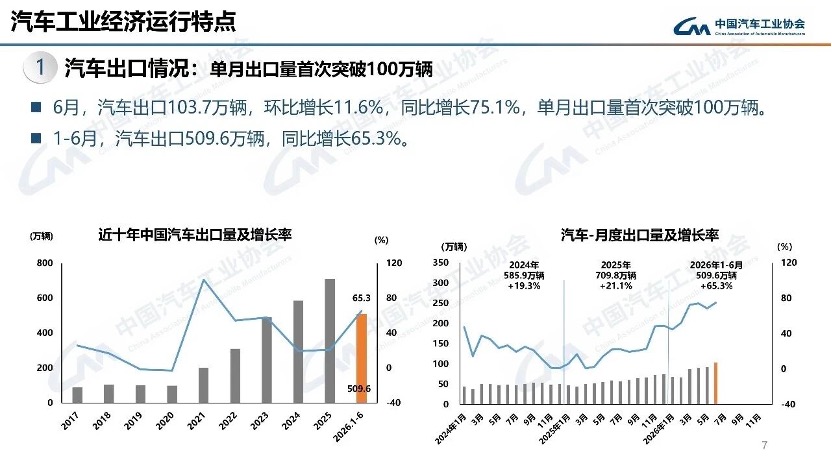
US consulting firm AlixPartners predicts that China's automobile exports are expected to reach 10 million units in 2026, making it the first country in the world to export over 10 million vehicles. As automobile exports scale from millions to tens of millions, the speed of growth marks a turning point of "quantitative increase leading to qualitative change"—whoever can build brand recognition overseas will truly occupy the next stage's high ground.
Overseas market policies tighten, and the essence of competition is shifting
In the past few years, the key to Chinese automakers' success overseas lay in "whether they could spread out"—channel coverage, dealer networks, and localized production capacity. But market signals from 2026 indicate that this logic is becoming ineffective.
On one hand, overseas market policy barriers are rapidly building up. Malaysia has set a minimum landing price of 200,000 ringgit and a power threshold of 180kW for imported pure electric vehicles starting July 2026; Thailand, Indonesia, and other countries are simultaneously tightening whole-vehicle imports, shifting to support local industries. The space for pure trade exports is narrowing.
On the other hand, consumer decision-making paths have been restructured. The first entry point for car selection is no longer the brand's official website, the dealer showroom, or even vertical automotive websites—it is the AI dialogue box.
What Can IPS Do? From "Post-Event Review" to "Pre-Event Prediction"
AI recommendation system rankings are becoming a more front-end traffic gateway than search engine rankings.
Unlike monitoring metrics limited to the domestic ecosystem, IPS covers multilingual tests across 16 countries, helping overseas-bound automotive brands see "in the eyes of local AI, where does my brand rank," rather than just "in the eyes of AI in China, where does it rank." This is equivalent to a global AI mind map.
Taking an automotive company preparing to launch a new model in Southeast Asia as an example, IPS can complete four layers of assessment before the vehicle hits the market:
First, gauge the market baseline. Before investing in R&D and marketing resources, first confirm whether the local AI has established brand awareness——does your brand exist in the recommendation pool of AI in Thailand? Is it "mentioned" or "recommended"?
Second, localization insights. Different countries and regions have different AI recommendation logics, and IPS's multilingual tests can reveal these differences.
Third, understand the competitive landscape. Which brands are recommended by local AI? Where do Chinese brands rank?
Fourth, consumption dimension preferences. Do Southeast Asian consumers (as reflected by AI) care more about cost-effectiveness or after-sales service? The IPS index score can accurately capture the consumption preferences presented by the AI end, providing a basis for product definition and marketing strategy adjustments.
Strategic Value for Decision-Makers: From “Feeling” to “Science”
For automotive CEOs and management, the value of IPS goes beyond marketing optimization; it lies in the scientific approach to strategic decision-making.
Data shows that the fit between IPS and terminal sales volume R² > 0.82, which can serve as a leading indicator for sales forecasting. Compared to lagging indicators such as the number of dealers and offline traffic, the AI recommendation index can better predict the market's true acceptance.
Relying on the nine-dimensional diagnostic capability of IPS, companies can precisely optimize the direction of R&D and marketing resource investment before launching vehicle models overseas, avoiding the mismatch of "channels laid out, but no sales volume." At the same time, when facing the capital market, they can use quantifiable AI mind-share data to demonstrate the brand's real influence among AI-native consumers.
In the Second Half of Automakers' Global Expansion, the Key Is the Ability to Be "Seen by AI"
IPS is essentially about providing automakers going global with a dynamically updated "Global AI Mindshare Map." It does not replace traditional market research but, in an era where AI has become consumers' "first decision gateway," fills the most critical missing piece: getting your brand onto AI's recommendation list.
Based on the above assessment, we believe the decision-making priorities for automakers expanding overseas should be adjusted as follows:
- Test before investing: Before launching a vehicle overseas, first use IPS to run an AI recommendation baseline test in the target market, and only then decide on product definition and marketing budget allocation.
- Regional precision: AI recommendation logic varies significantly across Southeast Asian countries—avoid a "one-size-fits-all approach."
- Long-term building: Improving AI recommendation rates is a systematic endeavor that requires sustained investment across dimensions such as content sources, semantic optimization, and brand visibility.
IPS that cares about your car—this is the critical step from "scaling overseas" to "winning mindshare overseas."