AI is becoming a key variable in users' car purchase decisions
Car purchase decisions are being rewritten by AI.
This is not a prediction for the future, but a reality unfolding right now. Survey data from multiple global markets points to the same conclusion: AI has deeply embedded itself into consumers' car purchase decision-making process. The vast majority of consumers, before visiting a showroom or contacting a brand, will prioritize using AI to complete their initial car selection analysis.
Global Data: AI Penetration Rate in Car Purchasing Continues to Rise
Let's look at a set of key data first.
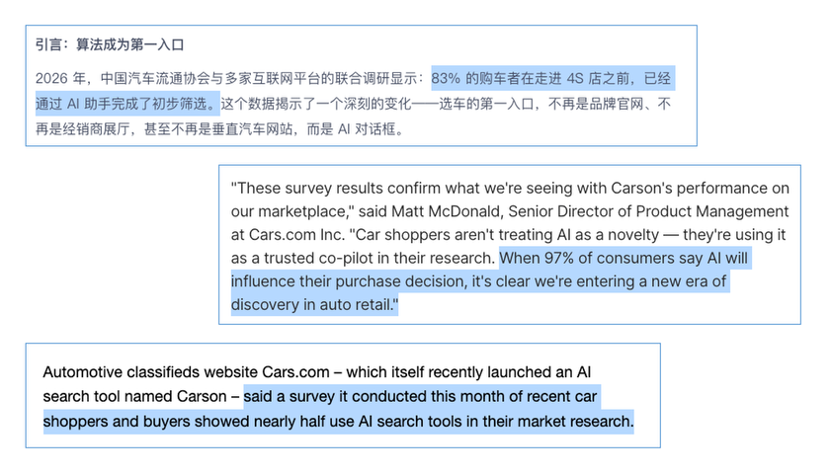
The change in the Chinese market is the most significant. According to iResearch's 2026 report, 88.6% of consumers use AI search to assist in decision-making before purchasing a car, with 44.0% using AI as their primary research tool and 44.6% as an important supplementary tool. This means nearly 90% of car buyers have already relied on AI to complete initial vehicle screening before actively contacting brands or dealerships.
Looking at overseas markets, the trend of AI-assisted car buying is also heating up. A survey by Cars.com, an automotive classified information website, found that nearly half of respondents use AI tools to gather information during the early research phase of car buying.
A broader cross-border survey further confirms this trend. McKinsey's "2026 Mobility Consumer Pulse Survey" covers five major markets—China, Germany, Japan, the UK, and the US—collecting samples from over 20,000 car owners. The report points out that digital channels are reshaping mass car-buying habits, with about two-thirds of consumers opting for omnichannel or online-dominated purchasing models. This trend is particularly evident among younger groups and EV buyers. The report also highlights a key signal: among car buyers under 45, 28% used AI-assisted decision-making during their last purchase. As AI continues to integrate into the car-buying journey, creating personalized consumer experiences will become a new competitive focus for automakers.
These data all point to one conclusion: AI is becoming an undeniable variable in consumers' car purchasing decisions.
AI's Role in Car Buying?
What do consumers use AI for? The core is information integration and comparative decision-making.
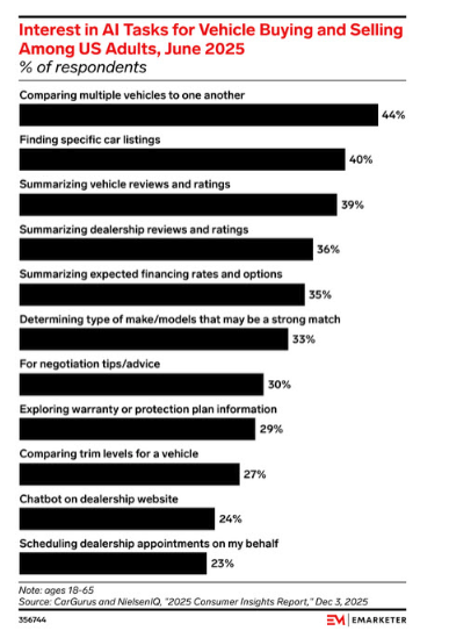
In Australia, 33% of car buyers use AI to compare vehicle specifications, 31% to check safety ratings and owner reviews, 28% to estimate total cost of ownership (TCO), and 23% to benchmark fair market prices (research from Close Brothers Motor Finance (CBMF)). In the U.S., over half (44%) of consumers are interested in using AI to compare multiple vehicles, making it the top application scenario for car-buying AI (CarGurus and NielsenIQ).
Compared to traditional car-buying research methods, AI consolidates information scattered across dozens of websites into direct answers, compressing the conventional chain of "keyword search — manual browsing — extensive filtering" into a one-step process of "natural language query — direct access to integrated answers." As the Cox Automotive research institute points out, AI car buyers experience a smoother research process, faster decision-making, and higher trust.
When Consumers Ask AI First Before Seeing the Car, What Does It Mean for Automotive Brands?
When consumers ask AI first before seeing the car, it means the logic of brand competition in the automotive industry is changing.
The logic of traditional marketing is “people search for information”——brands compete for users' search attention through keyword targeting and content marketing. In the AI era, the information distribution logic has shifted to “AI gives answers”——the brand and model information users see entirely depends on AI's source citation preferences.
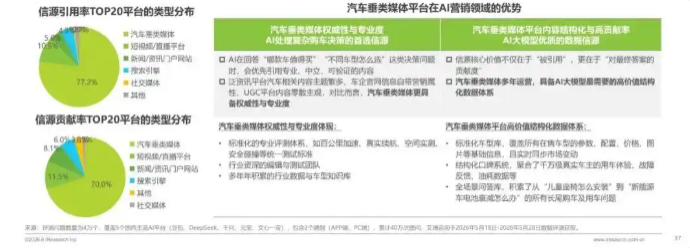
This means brands must not only let users “see” them but also make AI “cite” them. Among the TOP20 platforms by source citation rate in AI automotive responses, vertical automotive media account for 77.2% (iResearch, "2026 Automotive AI Decision Ecosystem White Paper"). Authority, structuralization, and content timeliness are becoming more critical competitiveness factors than keyword density.
Numbers vary by market, but the trend is highly consistent. AI has firmly occupied the key front-end node in users' car-buying decisions and will rewrite the traditional purchase journey.
For automotive brands, embracing AI, laying out AI sources, and adapting to AI decision logic is no longer an optional bonus but an essential for market foothold. When the first car-buying shortlist is written by AI, the battlefield for brands is no longer just the showroom and ad space——but whether your name appears in the answer AI gives.